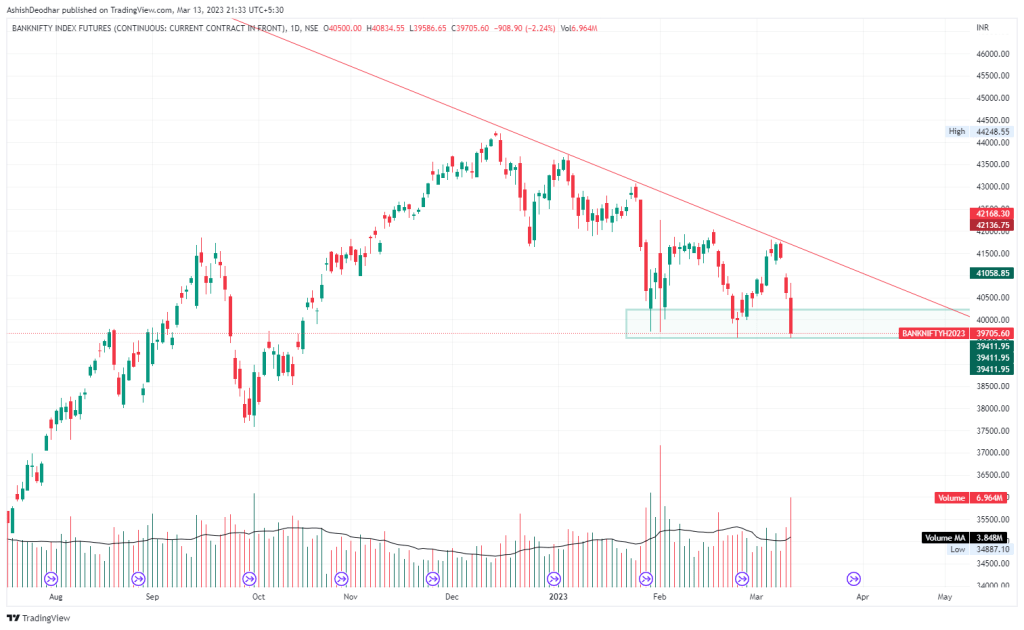
$NIFTYBANK.NSE has attempted for the fourth time the 39600 low. The one major difference from the last three attempts is that the selling pressure is far more intense today. Will the index bounce off this support again tomorrow or will it head downward?
On one hand, the US markets seem to be turning around. The fears of SVB contagion have been contained for now. That might offer some tailwind for $NIFTYBANK.NSE .
On the other hand, looking at purely the price action, buyers don’t appear to be anywhere in the vicinity. If the support of 39600 breaks tomorrow, we could see a further slide to 38000 – 37500.
I will back myself to go short again tomorrow if there’s any sign of weakness.
Abhimanyu is a brave and tragic hero in the Hindu epic, the Mahabharata. He is the son of Arjuna and Subhadra, the half-sister of Lord Krishna.
As an unborn child in his mother’s womb, Abhimanyu learns the knowledge of entering the deadly and virtually impenetrable Chakravyuh – a circular battle formation – from Arjuna. The epic explains that he overheard Arjuna talking about this with his mother from the womb. Arjuna spoke about entering Chakravyuh and later Subhadra dozed to sleep. Arjuna stopped explaining Chakravyuh escape when he saw Subhadra slept while listening. As an effect, the baby Abhimanyu in womb didn’t get a chance to know of coming out of it.
Fast forward to the 13th day of the battle of Kurukshetra – the epic war between Pandavas and Kauravas as narrated in Mahabharata – the Kauravas challenge the Pandavas to break the Chakravyuh.
The Pandavas accept the challenge since they know that the knowledge of how to defeat such a formation is known to Krishna and Arjuna.
However, on that day, Krishna and Arjuna are dragged into fighting a war on another front with the Samsaptakas. Since the Pandavas have accepted the challenge already, they have no choice but to attempt to use young lad Abhimanyu, who has knowledge on how to break into the formation but none whatsoever regarding how to break out of it. To make sure that Abhimanyu does not get trapped in this endeavour, the remaining Pandava brothers decide that they and their allies will also break into the formation along with Abhimanyu and assist the boy in breaking out of it.
On the fateful day, Abhimanyu uses his skills to successfully break into the formation. The Pandava brothers and allies attempt to follow him inside the formation, but they are effectively cut off by Jayadratha. Despite finding himself alone inside the Chakravyuh and surrounded by the entire Kaurava army, Abhimanyu fights valiantly, even arrogantly, until all the Kauravas, ignoring the prevailing codes of war, fight him simultenously and kill him1.
The moral of the Abhimanyu story is to always plan your actions with an end in sight. And there is a lesson to be drawn from it in the business of investing and trading.
In my experience of speaking to many “retail” investors – regular guys like us – who invest in the stock market, one peculiar thing stood out to me. It is that when we buy a stock or any other traded security, we don’t have a clear plan of why, when and how to get out. And there are the same few reasons that are regularly cited:
Buying and holding a stock is when you create real wealth
Much like Abhimanyu the fetus heard only half the story of chakravyuh, most of the investors I spoke to have either read or heard this “buy-and-hold-to-create-real-wealth” statement from somewhere without questioning that claim or even better backtesting its logic. They just accepted that as gospel truth. And yet, the evidence2 suggests otherwise.
Now don’t get me wrong. I am not advocating for constant portfolio churn. I am not saying one should exit a trade or an investment after a specified time or profit target or simply out of boredom. But there has to be a rational, grounded and backtested exit plan for every trade and investment. It could be based in fundamental or technical analysis, it could be entirely stop loss rule-based. But having an exit plan is important. Without one, it is all too common to see people sitting on huge losses or giving away considerable gains.
Many of my stocks are too deep in red. I don’t want to lose all that money. It will recover at some point
How many of you reading this are sitting on stocks with 20%, 30%, 50%, even 70% losses? How many of you hold stocks that are at the same level or very close to where you bought them many years ago? Some friends have even said jokingly to me that their stocks have corrected so much that they’ve now become “long-term investors” in the company.
This goes further than buy and hold. It becomes buy and hope!
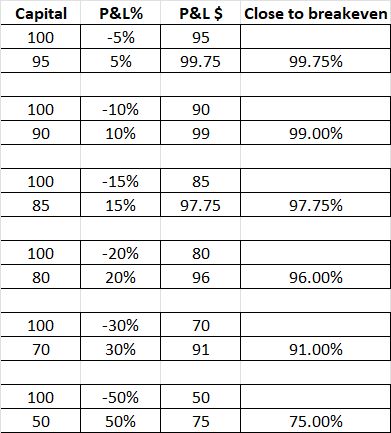
The problem is that we operate from the place of fear – the fear of booking losses or the fear of giving up notional profits if the prices go up after we exit the trade. And yet, losses are a reality not just in the business of investing but in life in general. Little do we realise that the deeper in loss we allow our positions to go, the harder our money has to work to get even to breakeven. The table below illustrates the point:
The deeper you’re in loss, the more difficult it is to recover from it
The more rational thing to do is to cut your losses short when you know that the investment you’ve made isn’t going in the direction you hoped. If you have an investment rationale or a trading plan, and if you follow it diligently, it’s impossible that you will always make losing trades. Even if you take small losses 60% of the time, the 40% of the time you get them right will more than make up for those losses.
I am good at buying but not very good at selling
This is either an extension of the earlier reason – I can’t sell a stock now that it is so deep in red / it has corrected so sharply from its high or it is a genuine issue about not having an exit plan. There’s nothing more to it than that.
It comes down to the individual level to determine which is it and work either on the psychology or the exit plan. Oftentimes, work is required on both fronts.
In conclusion
It is never wise to get into anything without having an exit plan – be it on battlefield, in trading or at extended family dinners.
It always pays to have planned out why, when and at what cost you’ll exit.
Cutting losses short and letting profits run is the best way to create wealth
Losses are an integral part of not only the business of investing but also life in general. Accepting those losses and moving on is always a healthier choice.
Caveat
In his seminal book ‘The art of thinking clearly’, Rolf Dobelli mentions ‘Confirmation bias’ as one of the major cognitive biases. I am very much mindful of my own confirmation bias in that I may have overlooked or even completely ignored evidence that supports never exiting an investment. That said, because I am fully aware of my own bias, I am always seeking information and evidence that challenges my own beliefs. I would be very grateful indeed if I am presented with evidence contrary to what I have presented.
In return, all I argue for and request of the reader is to have an open mind, recognise your own biases and do your own research / seek evidence that can challenge your own beliefs on this matter.
Somebody recently reached out to me seeking tips to be a full-time trader. I’ve had a lot of people reaching out to me with this express desire.
Trading does offer one the freedom from a 9-5 job, the chance to be one’s own boss, the owner of one’s own time and become financially independent. It is also one of the toughest jobs in the world.
So sharing a few tips I shared with him. Hope it helps you too.
1) Put a trading strategy in place first. The main components of that strategy are markets/sectors, timeframes, positing sizing, risk appetite, entry and exit rules. For example, I will only trade in Nifty 200 stocks on a weekly timeframe with not more than 10% of total capital allotted to one stock and not more than 1% risk per trade. I will enter when the price crosses above 50 EMA and exit at a drawdown of 5% (either 5% loss or 5% correction from the highest point). This is just an example. You can come up with your own strategy depending on the components you define.
2) Backtest that strategy. See if it really works. What profit % does it make on average. What is the highest drawdown. What is the win/loss ratio.
3) Have at least half a dozen strategies and backtest them and choose the top 1-2 strategies that work best.
4) Try paper-trading these strategies for a month at least to see if they actually work. That’s the risk free way of trying out your strategies in the live market. But if you want to trade with real money, start with only 1/3rd of the capital you’re intending to invest.
5) Once you gain confidence in your strategy and it starts showing results, then put in the rest of your money.
6) Start with cash segment first. Trading F&O without getting a grip on your strategy is like driving a Ferrari, drunk! That will never end well.
7) Finally, always remember that positioning sizing and risk management eat strategy for breakfast. You could have the best of strategies but if you take too large a position or don’t cut your losses quickly, you will end up blowing your account.
8) That’s where trading psychology comes into picture. You need absolute control over your emotions at all times. Stick to your risk management rules even if your gut tells you otherwise. There will be times when you take the loss and close the trade only for the trade to turn around. Part of life and we have to deal with it.
9) Trading is just like any other business. It’s not a casino or a lottery ticket. There’s no get-rich-quick scheme here. Many people I know to have lost a lot of money have done so because they thought they could double their capitals in a couple of months. Almost every one of them lost all their money in a couple of months.
10) Give it time. Be patient. Trading is like building a monument. One brick at a time. One trade at a time. You will earn 100 rupees and lose 40. If you keep doing that over a period of time, compounding will do its magic and you will grow your capital.
 Ashish Deodhar